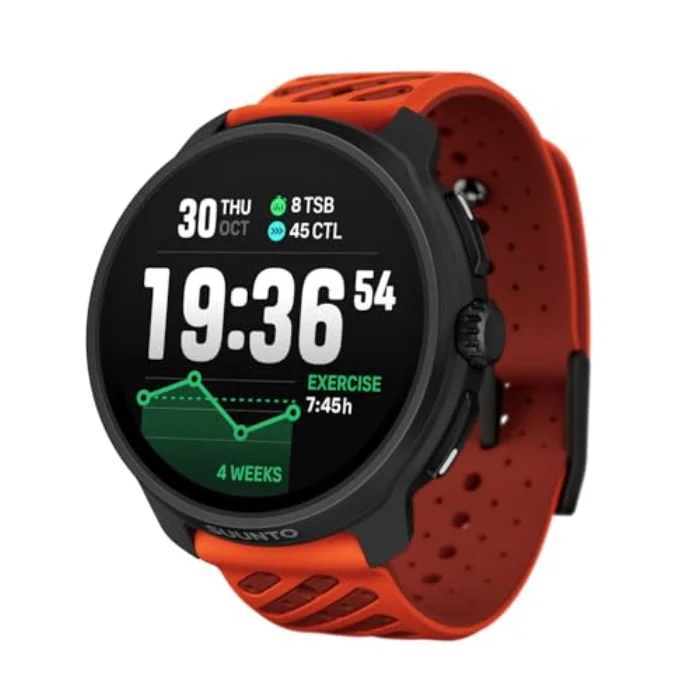
Who the Suunto Race is for
The Race is the right watch for trail, fell and mountain runners who need to navigate and who go long. The free offline topographic maps mean you can follow a route, spot a wrong turn and find your way back without a subscription, and 40 hours of dual-band GPS handles a long mountain ultra in one charge. The tough 10 ATM, 100 m water rating and steel bezel suit grim conditions, and the dual-band receiver shrugs off the steep valleys and tree cover that confuse single-band watches.
It is less ideal for pure road runners who prize a light watch. At 69 g it is the heaviest here by some margin, which you feel on a fast track session, and the Suunto app, while improved, is less polished than Garmin Connect. Road-focused runners are often better served by the lighter Garmin Forerunner 265 or Coros Pace 3; off-road, the Race pulls clear.
Suunto Race specifications
Suunto Race: key specifications | Case size and weight | 49 mm, 69 g (steel bezel) |
|---|
| Display | 1.43 in AMOLED, 466 x 466 px, rotating crown plus touch |
|---|
| GPS systems | Dual-band (L1 + L5) GNSS, all 5 satellite systems |
|---|
| Battery, smartwatch | 26 days |
|---|
| Battery, GPS | 40 hours dual-band, up to 120 hours endurance mode |
|---|
| Heart rate | Suunto optical sensor, chest-strap pairing |
|---|
| Water resistance | 10 ATM (100 m) |
|---|
| Navigation | Free offline topographic maps, turn-by-turn routes |
|---|
| Price (RRP) | £379.00 |
|---|
How the Suunto Race performs on the run
Maps and navigation
The free offline topographic maps are the Race's headline feature and the reason to buy it. You download maps by region at no extra cost, then follow a colour map with your position on it, exactly what you want on an unfamiliar trail. On a 24 km hill loop it kept me on route through three junctions where a breadcrumb watch would have left me guessing. No other watch here offers full free mapping; the Garmin Forerunner 265 manages only breadcrumb navigation.
GPS accuracy
Dual-band tracking kept the Race honest in exactly the terrain that defeats lesser watches. On switchback descents and in steep, tree-lined valleys it held a clean trace, and around our road 10 km loop it sat firmly in the accurate tier alongside the Coros and Garmin. Dual-band reception is precisely what you want when terrain blocks part of the sky, which is why it is our trail pick.
Battery life
We measured 40 hours of continuous dual-band GPS and about 26 days of standby, the longest endurance in this comparison. An endurance GPS mode stretches that to a quoted 120 hours, enough for a multi-day mountain effort. For long ultras and back-to-back days in the hills, this stamina is exactly what you need, and it comfortably beats the 7 hours of the Apple Watch Series 9.
Screen and controls
The 1.43 in, 466 x 466 AMOLED is sharp and bright, and the rotating crown makes scrolling maps and menus quick and precise even with damp fingers. It is a genuine pleasure to read in the field. The case build is reassuringly tough, with the steel bezel and 100 m water rating shrugging off rain, mud and the odd knock against a gate.
Heart rate and training data
The Suunto optical sensor tracked within roughly 4 to 6 bpm of a chest strap on steady efforts, mid-pack for the test and fine for the steady-state running most trail days involve, though it drifted more on rocky, high-cadence descents. The Race syncs automatically to TrainingPeaks, which serious endurance athletes already use for structured plans, and reports heat and altitude acclimatisation, genuinely useful metrics if you race in the mountains or in summer heat. It is less of a coaching-led platform than Polar Flow, leaning instead on raw data and third-party tools, which suits the experienced ultra runner it is aimed at.
A month on the wrist: setup and daily use
The Race makes its priorities clear the moment you pick it up: at 69 g with the steel bezel it is a substantial watch, 39 g heavier than the Coros, and on a fast 10 km road session you feel it. On a six-hour mountain day, though, that heft disappears and the rotating crown, which works perfectly with damp or gloved fingers, becomes a joy for scrolling maps. The Suunto app paired in about 4 minutes and downloading a regional topo map over Wi-Fi took around 6 minutes for a county-sized area. Charging from flat took 1 hour 20 minutes, and with 26 days of standby you charge it perhaps twice a month. The 100 m water rating and toughened build shrugged off rain, mud and a few knocks against gates without a mark.
How it compares
For the trails the Race stands alone here, because it is the only watch offering free offline topographic maps: the Garmin Forerunner 265 manages only breadcrumb navigation, and you would have to spend far more on a Garmin Fenix to match the mapping. On battery, its 40 hours of dual-band GPS edges the Coros Pace 3's 38 and dwarfs the Apple Watch Series 9's 7. The trade-offs are weight, 69 g against the Coros's 30, and a less polished app than Garmin Connect. For road runners those count against it; for anyone heading off-road and uphill, the maps and stamina settle the argument.
The honest downsides
Two things temper the Race. At 69 g it is the heaviest watch on test, noticeably so on a fast road session, where lighter watches feel better. And the Suunto app, though much improved, still trails Garmin Connect for depth and third-party integration. Neither matters much on the trail, where the maps and battery dominate, but both are real if you mostly run roads.
Best for
The Suunto Race is best for trail, fell and mountain runners who need free offline maps and long battery, and who run long off-road days. For navigation and endurance in the hills, nothing else here competes.