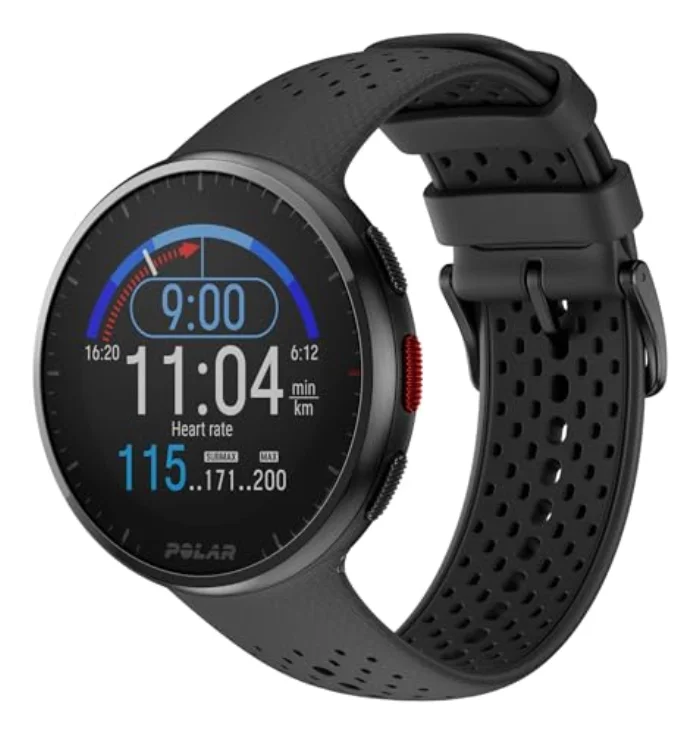
Who the Polar Pacer Pro is for
The Pacer Pro is the right watch for the runner who wants to be coached: someone working through a structured block, returning from injury and watching their load, or training by heart-rate zones for the first time. Polar Flow presents recovery and training load more readably than any rival, and FitSpark removes the guesswork of what to do today. The light 41 g case and hardware buttons also make it a sensible winter watch you can operate with gloves on.
It is less suited to runners who prize a vivid screen or pinpoint city GPS. The 240 x 240 memory-in-pixel display looks dated next to the AMOLED on the Garmin Forerunner 265, and its single-band GPS drifts more than the dual-frequency Coros Pace 3 in built-up areas. If guidance is your priority, those are easy trade-offs; if raw accuracy or a bright screen is, look elsewhere.
Polar Pacer Pro specifications
Polar Pacer Pro: key specifications | Case size and weight | 45 mm, 41 g |
|---|
| Display | 1.2 in MIP, 240 x 240 px, always-on, hardware buttons |
|---|
| GPS systems | Single-band GNSS: GPS, GLONASS, Galileo, QZSS, BeiDou |
|---|
| Battery, smartwatch | 7 days |
|---|
| Battery, GPS | 35 hours continuous GPS |
|---|
| Heart rate | Precision Prime 10-LED optical sensor, chest-strap pairing |
|---|
| Water resistance | 3 ATM (30 m) |
|---|
| Coaching tools | FitSpark, Running Performance Test, Training Load Pro |
|---|
| Price (RRP) | £219.00 |
|---|
How the Polar Pacer Pro performs on the run
Coaching and training guidance
This is the Pacer Pro's reason to exist. FitSpark reads your recovery and serves a ready-made session each day, from easy runs to interval and tempo workouts with on-screen prompts. The Running Performance Test, a guided 20-minute effort, set my personal pace and heart-rate zones, and Training Load Pro showed clearly whether each week was building fitness or tipping into overreach. After every run, Polar Flow distilled it into a readable readiness score. No watch here makes the why of training as clear.
Heart rate accuracy
Polar's 10-LED Precision Prime sensor was the most accurate wrist heart rate in our comparison, tracking within 2 bpm of a paired H10 chest strap across steady runs. On hard intervals it still lagged the strap by a few beats, as all wrist sensors do, and cold weather widened the gap, but for the majority of training it is genuinely dependable, which matters because the whole coaching system rests on accurate heart-rate data.
GPS accuracy
GPS is the Pacer Pro's weaker suit. Around our 10 km loop it drifted roughly 2.1% in the built-up section, more than the dual-frequency Coros (0.4%) or Garmin (1.2%), though on open roads and trails the error fell below 1.5%. For training and most racing it is perfectly usable; for chasing exact city splits, a dual-frequency watch is more reliable. Our GPS accuracy explainer covers the difference.
Battery and screen
We measured 35 hours of continuous GPS, enough for any race distance, and about 7 days of standby. The 240 x 240 memory-in-pixel screen is always-on, sips power and reads well in sunlight, but it is plainly lower-resolution than an AMOLED. The hardware buttons, though, are a real plus in winter, working flawlessly with gloves where a touchscreen struggles.
A month on the wrist: setup and daily use
The Pacer Pro weighs a comfortable 41 g and the Polar Flow app paired in about 4 minutes, walking you through the Running Performance Test on day one to calibrate your zones. The five hardware buttons are the highlight of daily use: they worked flawlessly through winter gloves on a 5 C morning, where every touchscreen here struggled. Charging from flat took 1 hour 30 minutes on the USB cradle, and the 7-day standby means you charge it roughly once a week. The standout is what happens after the run, not during it: Polar Flow on the phone turns each session into a clear readiness score and a load chart, and that web platform is the most genuinely useful coaching tool of any watch on test, free of charge.
How it compares
At £219 the Pacer Pro sits directly against the Coros Pace 3, and the choice is clear-cut: Polar wins on coaching software and wrist heart rate (within 2 bpm of a strap, the best here), Coros wins on GPS accuracy (0.4% versus 2.1%) and battery (38 hours versus 35). Against the Garmin Forerunner 265 at twice the price, the Pacer Pro concedes the brighter screen and sharper GPS but arguably reads recovery and load more clearly. If your priority is being told what to run and when to rest, rather than chasing the tightest GPS trace, the Polar earns its place; if exact splits matter more, the Coros does.
One detail decides it for many runners: the quality of the wrist heart-rate data, because the entire coaching system is only as good as the numbers feeding it. The Pacer Pro's 10-LED Precision Prime array was the standout in our heart-rate testing, holding within 2 bpm of a chest strap across steady runs, where the Coros sat 4 to 6 bpm out and the Amazfit 6 to 9 bpm. That accuracy is why Polar's FitSpark sessions and Training Load Pro scores feel trustworthy rather than approximate. If you train strictly by heart-rate zones and would rather not wear a chest strap on easy days, the Pacer Pro is the watch here that comes closest to making the strap optional, and that, more than the GPS or the screen, is its real argument.
The honest downsides
The Pacer Pro asks you to accept two things for its coaching. The single-band GPS is the least accurate of the dual-frequency-equipped watches here, drifting around 2.1% in cities, and the memory-in-pixel screen looks dated beside the AMOLED rivals. The 3 ATM water rating is also lower than the 5 ATM of most rivals, so it is splash-proof rather than swim-ready.
Best for
The Polar Pacer Pro is best for the runner who wants to be coached: anyone following a structured plan, training by heart-rate zones or managing recovery and load. If you want a watch that tells you what to run and when to rest, this is the one.