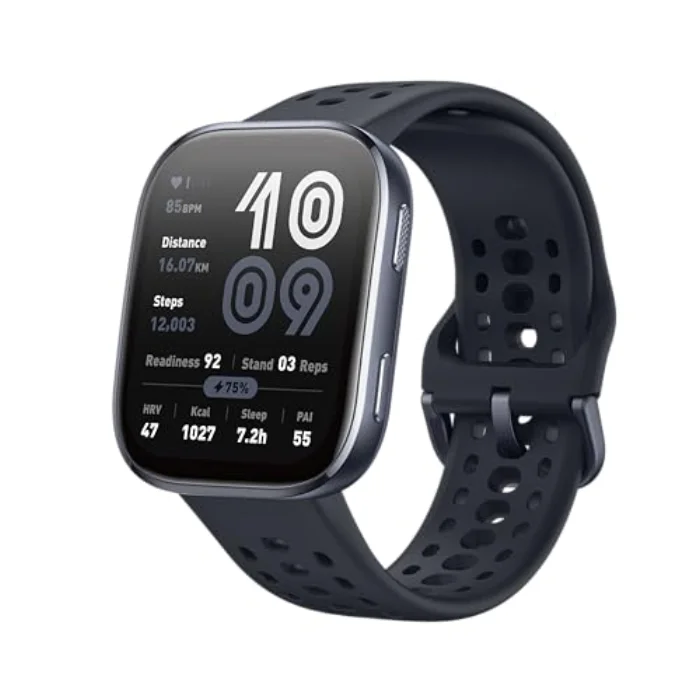
Who the Amazfit Bip 5 is for
The Bip 5 is the right watch for the new runner, the casual runner, or anyone who wants a cheap, reliable back-up. If you are starting a Couch to 5K, training for your first parkrun, or simply want to know roughly how far and how fast you ran without spending much, it does the job for the price of a pair of decent trainers. The 26 g case suits smaller wrists, and the huge display means you never squint at your pace mid-run.
It is the wrong watch if you chase exact splits or race on accurately measured courses. Its single-band GPS drifts more than the dual-frequency Coros Pace 3, so a measured 10 km can read long. It is also IP68 only, so it is not for swimmers. Runners who need precision should step up to the Pace 3, which is the natural upgrade and our buying guide top value pick.
Amazfit Bip 5 specifications
Amazfit Bip 5: key specifications | Case size and weight | 45.9 mm, 26 g |
|---|
| Display | 1.91 in LCD, 320 x 380 px, the largest screen on test |
|---|
| GPS systems | Single-band, 5 systems (GPS, GLONASS, Galileo, BeiDou, QZSS) |
|---|
| Battery, smartwatch | 10 days typical use |
|---|
| Battery, GPS | 26 hours continuous GPS |
|---|
| Heart rate | BioTracker optical sensor, SpO2 measurement |
|---|
| Water resistance | IP68 (splash and rain, not swim-rated) |
|---|
| Sport modes | 120+ tracked activities, Bluetooth calls |
|---|
| Price (RRP) | £59.99 |
|---|
How the Amazfit Bip 5 performs on the run
GPS accuracy
This is the watch's clear weakness, and we will be straight about it. Around our tape-measured 10 km loop the Bip 5 recorded up to 10.35 km, an error of 3.5%, and the trace visibly zig-zagged along the tree-lined river path where the dual-frequency watches drew a clean line. On open roads the error shrank to around 1.5%, which is acceptable. Track laps came back between 393 m and 409 m, a 16 m spread that tells you it is fine for training but not for chasing seconds. If accurate distance is your priority, our GPS accuracy explainer sets out why and points you to better options.
Battery life
Battery is where the Bip 5 surprises. We measured 26 hours of continuous GPS, which is longer than the £399 Apple Watch Series 9 manages, and around 10 days of normal smartwatch use. That 26 hours covers a marathon with a wide margin. The big always-on screen is the main drain, so letting it sleep between glances stretches battery noticeably further.
The screen
At 1.91 in and 320 x 380 px, the Bip 5 has the largest, most legible display in this comparison, and it is genuinely the watch's best feature. Pace, distance and time are easy to read at a glance even at speed, which matters more for a new runner than a sharper, smaller AMOLED would. It is an LCD rather than AMOLED, so colours are flatter and sunlight readability is good rather than great, but for the money it is excellent.
Features and software
The Zepp app is straightforward, with 120+ sport modes, a basic VO2 max estimate, sleep and SpO2 tracking and Bluetooth calls from the wrist. None of it is as deep as Garmin Connect or Polar Flow, but it covers everything a beginner needs and a fair bit more. There is no running power, no recovery score and no on-board music, which is exactly the level you expect at this price.
Heart rate and sensors
The BioTracker optical sensor was the least precise here, as you would expect at the price, reading within roughly 6 to 9 bpm of a chest strap on steady runs and lagging by 12 to 15 bpm at the start of intervals before settling. For easy runs and general fitness that is perfectly serviceable; for zone-based interval training it is the one watch here we would not lean on without a strap, and the Bip 5 does at least pair with a Bluetooth chest strap if you want one. It also logs sleep, stress and SpO2, though these are best read as trends rather than clinical numbers.
A month on the wrist: setup and daily use
The Bip 5 is the lightest watch on test at 26 g, and on a slim wrist it is barely there. The Zepp app paired in about 3 minutes and the plastic case and silicone strap caused no irritation across four weeks, although the build feels exactly as budget as the price suggests next to the metal-bezel Suunto. Charging from flat took 2 hours on the magnetic pin charger, but since it runs for 10 days of normal use you rarely think about it. The single side button plus touchscreen is simple to learn, the big screen makes mid-run glances effortless, and Bluetooth calls from the wrist are a genuinely useful extra you do not get on watches three times the price.
How it compares
Nothing else here is close on price: at £59.99 the Bip 5 is a fifth of the cost of the Garmin Forerunner 265 and a third of the Coros Pace 3. It even beats the £399 Apple Watch Series 9 on GPS battery, 26 hours against 7. What you give up is precision and depth: single-band GPS drifts up to 3.5% where the dual-frequency watches stay under 1.5%, there is no running power or recovery score, and the LCD is flatter than an AMOLED. As a first watch or a cheap back-up, that trade is easy to make; once you start chasing exact splits, the Coros is the upgrade.
The honest downsides
Two limits define the Bip 5. First, single-band GPS means it is not for precise pacing or measured races, with drift up to 3.5% on hard routes. Second, the IP68 rating covers rain and sweat but not swimming, so triathletes and pool swimmers need a 5 ATM watch instead. Neither is a flaw at the price; they are simply the lines Amazfit drew to hit £59.99.
Best for
The Amazfit Bip 5 is best for new and casual runners who want a big, clear screen and long battery on the tightest budget, and for anyone needing an inexpensive back-up watch. As a first GPS watch it delivers far more than its price suggests.