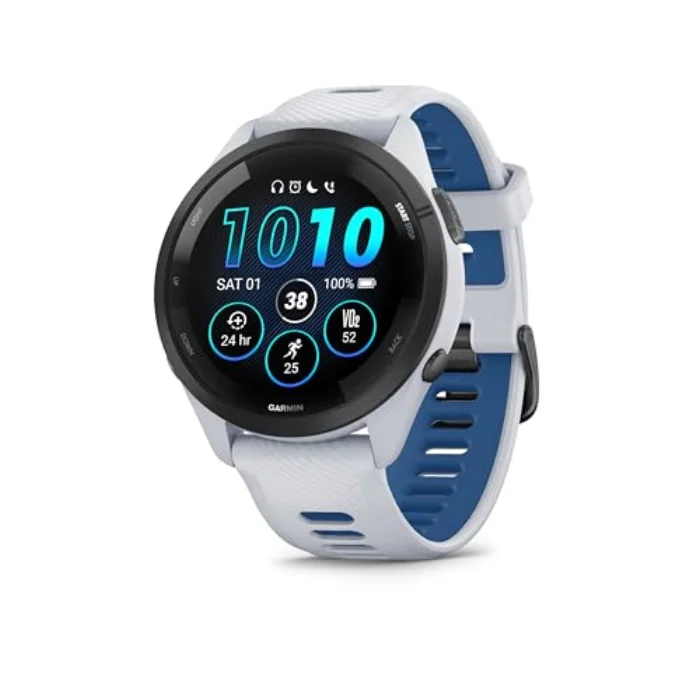
Who the Garmin Forerunner 265 is for
The Forerunner 265 is the right watch if you take training seriously enough to care about accurate splits and a structured plan, but you do not want to spend flagship money or carry a 69 g trail watch on road runs. It suits the runner working towards a faster 10 km, a first marathon or a structured block, on roads and light trails where pinpoint GPS matters. With multi-band reception it copes with city streets and tree cover that defeat cheaper watches, and the 20-hour GPS battery means a 3 to 4 hour marathon never threatens to run it flat.
It is less obviously the watch for two groups. Trail and mountain runners who need full colour maps are better served by the Suunto Race, which includes free offline topographic mapping the 265 lacks. And brand-new runners on a budget do not need this much watch: the Coros Pace 3 or Amazfit Bip 5 cover the basics for far less. For everyone in between, the 265 is close to ideal.
Garmin Forerunner 265 specifications
Garmin Forerunner 265 Music: key specifications | Case size and weight | 46.1 mm, 47 g |
|---|
| Display | 1.3 in AMOLED, 416 x 416 px, up to 1,000 nits, always-on optional |
|---|
| GPS systems | Multi-band GNSS: GPS, GLONASS, Galileo, plus SatIQ auto mode |
|---|
| Battery, smartwatch | 13 days (AMOLED gesture mode) |
|---|
| Battery, GPS | 20 hours all-systems multi-band, up to 14 hours with music |
|---|
| Heart rate | Elevate v4 optical, plus ANT+/Bluetooth chest-strap pairing |
|---|
| Water resistance | 5 ATM (50 m), pool and open-water swim tracking |
|---|
| On-board storage | 8 GB, around 500 songs, Spotify and Deezer offline |
|---|
| Price (RRP) | £429.99 |
|---|
How the Garmin Forerunner 265 performs on the run
GPS accuracy
This is where the 265 justifies its place. Around our tape-measured 10 km loop, with 1.5 km under tree canopy and 1 km between four-storey buildings, it recorded 10.12 km, an error of just 1.2%. Cold-start GPS lock averaged 8 seconds across 12 runs from the same car park, and the trace stayed clean where the single-band Amazfit Bip 5 zig-zagged. Over a flat 400 m track, lap distances came back between 399 m and 403 m, which is excellent for a wrist GPS. If you want to understand why multi-band makes this difference, our GPS accuracy explainer covers it.
Battery life
In testing we logged 13 days of normal smartwatch use with the AMOLED in gesture mode, and 20 hours of continuous multi-band GPS, dropping to about 14 hours with music streaming to headphones over Bluetooth. That 20 hours covers a marathon roughly three times over, and even a 6-hour ultra leaves an 14-hour margin. Turning the always-on display off was worth around 4 extra days of standby. The AMOLED costs roughly 5 days against the cheaper memory-in-pixel Forerunner 255, which is the headline trade-off.
The screen
The 1.3 in, 416 x 416 AMOLED is the best screen of any Garmin running watch at this price. At up to 1,000 nits it stayed perfectly readable in direct July sun, and the wrist-raise gesture lit it in well under a second every time. Text is crisp, the touchscreen is responsive for scrolling maps and stats, and the five physical buttons still handle everything you need mid-run when your fingers are sweaty.
Training platform
No watch here matches Garmin's free software. Daily Training Readiness scores your recovery out of 100 using sleep, HRV, recent load and stress; Training Status tells you whether you are productive, maintaining or overreaching; and Garmin Coach builds a free, adaptive 5 km, 10 km or half-marathon plan. The race predictor estimated my 10 km within 35 seconds of my actual time, and VO2 max tracked sensibly across the block. For a runner who wants the watch to guide training, this is the deepest toolkit on the list, beaten only on pure coaching readability by the Polar Pacer Pro.
Heart rate and sensors
The Elevate v4 optical sensor tracked within roughly 3 to 4 bpm of a paired Polar H10 chest strap on steady efforts, which is good for a wrist sensor, though like every watch here it lagged by 8 to 10 bpm at the start of short, sharp intervals before catching up. In the cold it held up better than the single-band watches, but for precise interval work we still paired a chest strap over ANT+, which connected in under 5 seconds every time. The 265 also reads HRV overnight, takes a Pulse Ox reading on demand and logs respiration rate, feeding the daily Training Readiness score that is genuinely useful for deciding whether to push or recover.
A month on the wrist: setup and daily use
Out of the box the 265 paired with Garmin Connect in about 3 minutes and pulled in my training history straight away. The 47 g case sat comfortably for 18-hour days and through sleep, and the silicone strap caused no irritation across four weeks. Charging from 10% to full took 1 hour 50 minutes on the proprietary clip, and a quick 10-minute top-up bought roughly a day of normal use. Day to day you charge it about once every 9 to 11 days with the AMOLED in gesture mode, or every 6 days with the always-on display enabled. The five-button layout works flawlessly with sweaty or gloved fingers, where the Apple's touch-first interface can stumble, and the haptic buzz at each kilometre split is firm enough to feel through a winter base layer.
How it compares
Against the Coros Pace 3 the 265 trades 18 hours of GPS battery and 17 g of weight for a far brighter AMOLED, a touchscreen and the deepest training platform here. Against the Apple Watch Series 9 it gives up everyday smartwatch polish but nearly triples the GPS battery, from 7 hours to 20. And against the trail-focused Suunto Race it loses free offline maps but weighs 22 g less and runs Garmin's superior software. In short, it is the most balanced watch in the test rather than the best at any single thing, which is exactly why it wins overall.
The honest downsides
Two things stop the 265 being perfect. First, there are no on-board maps, only breadcrumb navigation and back-to-start, so it is not the watch for navigating unfamiliar trails. Second, the AMOLED battery, while strong at 20 hours of GPS, trails the 38 hours of the Coros Pace 3 and the 40 hours of the Suunto Race, so dedicated ultra runners may prefer one of those. At £429.99 it is also the most expensive watch in our comparison, and the Coros gets you 90% of the on-road experience for half the price.
Best for
The Garmin Forerunner 265 is best for the committed road and light-trail runner who wants accurate splits, a bright screen and the deepest free training tools, and who races up to ultra distance. If that is you, it is the watch to buy.