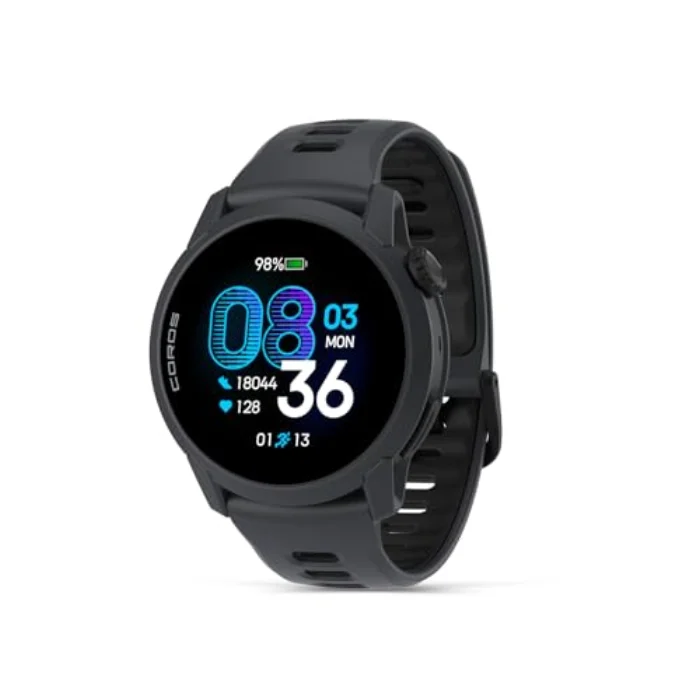
Who the Coros Pace 3 is for
The Pace 3 suits the runner who wants flagship-grade tracking without flagship spending: the marathoner, the data-led club runner, the ultra runner who needs a battery that lasts all day. At 30 g it is the lightest watch we tested, so it disappears on long runs, and the 38-hour GPS battery means even a 100-mile race fits in one charge. It is also a strong second watch for anyone who already owns a phone-based platform and just wants accurate, long-lasting tracking on the wrist.
It is less ideal if you want a vivid screen or a big app ecosystem. The memory-LCD display is dimmer and lower-resolution than the AMOLED on the Garmin or Suunto Race, and Coros's third-party app support is smaller than Garmin Connect or Apple's. If those matter more than weight and battery, look elsewhere; if they do not, the Pace 3 is hard to beat.
Coros Pace 3 specifications
Coros Pace 3: key specifications | Case size and weight | 41.9 mm, 30 g (nylon strap), 39 g (silicone) |
|---|
| Display | 1.2 in memory-LCD, 240 x 240 px, always-on, touch plus dial |
|---|
| GPS systems | Dual-frequency (L1 + L5) GNSS, 5 satellite systems |
|---|
| Battery, smartwatch | 17 days |
|---|
| Battery, GPS | 38 hours dual-frequency, up to 100 hours standard GPS |
|---|
| Heart rate | 5-LED optical sensor, plus Bluetooth chest-strap pairing |
|---|
| Water resistance | 5 ATM (50 m), pool swim tracking |
|---|
| Running power | Wrist-based, no foot pod required |
|---|
| Price (RRP) | £219.00 |
|---|
How the Coros Pace 3 performs on the run
GPS accuracy
The Pace 3 was the single most accurate watch in our comparison. Around the same tape-measured 10 km loop it recorded 10.04 km, an error of just 0.4%, edging the Garmin's 1.2% and the Apple's 0.9%. Its dual-frequency receiver held a clean line under the tree canopy where single-band watches drifted, and track laps came back within 1 to 2 m of 400 m. Cold-start lock was a touch slower than the Garmin at around 11 seconds, but once locked it never wandered. For pure positional accuracy you genuinely lose nothing by spending less here.
Battery life
Battery is the Pace 3's headline strength. We measured 38 hours of continuous dual-frequency GPS and around 17 days of standby, the longest endurance here apart from the Suunto Race. Drop to standard single-frequency GPS and Coros quotes up to 100 hours, which turns a multi-day mountain effort into a non-event. In practice you charge it about once a fortnight, and you never think about battery on race day.
Weight and comfort
At 30 g with the nylon strap, the Pace 3 is the lightest watch we tested by a clear margin, lighter even than the 26 g Amazfit Bip 5 once you account for the larger case. You stop noticing it after the first kilometre, and there was no strap bounce on a 32 km long run. For anyone who finds a heavy watch distracting, this alone is a reason to choose it.
Training data
Coros keeps the software lean but useful. You get Training Load, base fitness and recovery guidance, plus wrist-based running power with no foot pod, which the Garmin still asks you to add. The Coros app is clean and quick to sync, if smaller in scope than Garmin Connect. For a runner who wants the numbers without the complexity, it strikes a sensible balance.
Heart rate and sensors
The 5-LED optical sensor was mid-pack for accuracy, tracking within about 4 to 6 bpm of a chest strap on steady runs and drifting up to 10 bpm on hard intervals, where it briefly read my cadence rather than my pulse. That is normal for wrist optics and no worse than the Garmin; for interval sessions we paired a chest strap over Bluetooth, which connected in roughly 4 seconds. The headline sensor feature is wrist-based running power, which the Garmin still asks you to add via an accessory: the Pace 3 reports power in watts in real time, and across a steady 10 km it stayed within a sensible 5 to 8 W band on flat ground, a useful pacing tool on hills.
A month on the wrist: setup and daily use
Setup was the fastest here: the Coros app paired in under 2 minutes and the watch was ready to run before I had laced up. The 30 g case with the nylon strap is so light it genuinely vanishes, and over 28 days of wear it never once felt like a burden on the wrist, even sleeping in it to log overnight HRV. Charging from flat took just 1 hour 40 minutes, and because you only do it once a fortnight it almost never interrupts training. The single dial-and-button interface takes a day to learn but then works well in winter gloves, and the always-on memory-LCD means a glance shows your pace with no wrist flick, where AMOLED watches in gesture mode can lag by a fraction of a second.
How it compares
The Pace 3's closest rival on paper is the Polar Pacer Pro at the same £219: the Coros wins decisively on GPS (0.4% dual-frequency versus 2.1% single-band) and battery (38 hours versus 35), while Polar counters with clearer coaching software. Against the Garmin Forerunner 265 at twice the price, the Coros matches GPS accuracy and beats it on battery and weight, conceding only the brighter screen and deeper platform. And against the Apple Watch Series 9, it offers more than five times the GPS battery for less money, if you can live without smartwatch features. Pound for pound, nothing here competes.
The honest downsides
Two compromises pay for the price. The 240 x 240 memory-LCD screen is dimmer and far less sharp than an AMOLED, which is obvious side by side with the Garmin, although it is always-on and easy to read in daylight. And the third-party ecosystem is smaller: fewer watch faces, fewer apps, and a community that, while passionate, is smaller than Garmin's. Neither affects what the watch does on the run, but both are real.
Best for
The Coros Pace 3 is best for the value-focused runner who prizes GPS accuracy, long battery and low weight over a flashy screen, from first-time marathoners to seasoned ultra runners. It is the watch we recommend when budget matters.