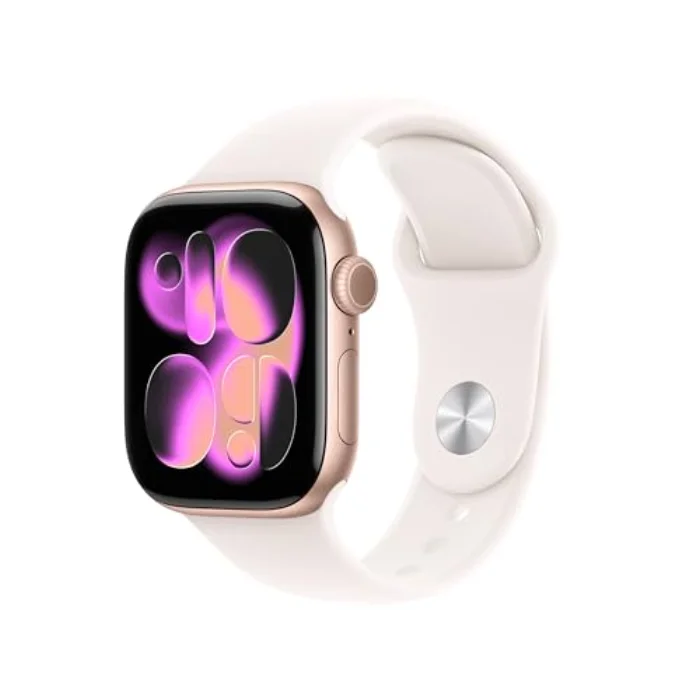
Who the Apple Watch Series 9 is for
The Series 9 is the right watch for the iPhone owner who wants one device for everything: messages, payments, music, health and running, with accurate GPS as part of the package. If your races are 5 km, 10 km, parkruns or sub-3-hour marathons, the 7-hour GPS battery is never a problem, and you get the best everyday smartwatch on the market alongside genuinely good run tracking. ECG, fall detection and a vast app library are bonuses no dedicated running watch matches.
It is the wrong watch for two groups. Android users cannot use it at all, full stop. And runners who race long, slow marathons or ultras will outlast its 7-hour GPS battery, where the Coros Pace 3 manages 38 hours and the Suunto Race 40. If race-day battery or multi-day endurance matters, a dedicated watch is the safer buy.
Apple Watch Series 9 specifications
Apple Watch Series 9 (45 mm GPS): key specifications | Case size and weight | 45 mm, 51 g (aluminium) |
|---|
| Display | 1.9 in LTPO OLED, up to 2,000 nits, always-on |
|---|
| GPS systems | Dual-frequency (L1 + L5) GPS, GLONASS, Galileo, BeiDou |
|---|
| Battery, smartwatch | 18 hours typical, 36 hours low-power mode |
|---|
| Battery, GPS | around 7 hours continuous GPS workout |
|---|
| Heart rate | 3rd-gen optical sensor, ECG, blood-oxygen, temperature |
|---|
| Water resistance | 5 ATM (50 m), WR50, swim tracking |
|---|
| Compatibility | iPhone only (watchOS) |
|---|
| Price (RRP) | £399.00 |
|---|
How the Apple Watch Series 9 performs on the run
GPS accuracy
This was the biggest surprise of our testing. Around the tape-measured 10 km loop the Series 9 recorded 10.09 km, an error of just 0.9%, second only to the Coros Pace 3 and ahead of the Garmin. Its dual-frequency receiver kept the trace tight even between tall buildings, and track laps came back within 2 to 4 m of 400 m. Anyone who still thinks the Apple Watch cannot track a run accurately has not used a recent one.
Battery life
Battery is the watch's defining limitation for runners. We measured around 7 hours of continuous GPS, by far the shortest in this comparison; the budget Amazfit Bip 5 lasts 26. That 7 hours covers a sub-3-hour marathon and any shorter race comfortably, but a 4-hour-plus marathon can run it flat in the final miles, and it needs daily charging in everyday use. Low-power workout mode extends GPS life, at the cost of some sensor frequency.
The screen
The 1.9 in LTPO OLED, peaking at 2,000 nits, is the brightest and sharpest display in this whole comparison. In direct sun it remained effortlessly readable, and the always-on mode means a quick glance shows your pace without a wrist flick. As a piece of screen technology nothing here comes close, and it makes the watch a pleasure to use all day.
Running features and ecosystem
The workout app now supports custom intervals, pace and heart-rate-zone targets, and a race-route feature that paces you against a previous effort. Heart rate tracked within roughly 4 to 5 bpm of a chest strap on steady runs. Where it pulls away from every rival is the wider ecosystem: third-party run apps like Strava and Runna, Apple Pay mid-run, music, calls and a health platform no dedicated watch matches. The flip side is that all of this assumes an iPhone.
A month on the wrist: setup and daily use
For an iPhone owner the Series 9 is the easiest watch here to live with: it paired in under a minute and pulled in apps, contacts and Apple Pay automatically. The 45 mm aluminium case weighs 51 g, the heaviest road watch on test bar the Suunto, but the soft sport band spread the load and it was comfortable across 16-hour days. The real friction is charging. We charged it every single night, and a full top-up took about 1 hour 5 minutes on the magnetic puck, with a fast 15-minute charge buying roughly 8 hours of normal use. That nightly ritual is fine if you do not track sleep, but it is a genuine change of habit coming from a Garmin you charge once a week. The Digital Crown and side button are precise, though the touch-first interface is fiddlier than physical buttons when your hands are wet or cold.
How it compares
Against every dedicated running watch here the Series 9 wins on screen and smartwatch features and loses on battery. Its 7 hours of GPS is less than a fifth of the Coros Pace 3's 38 hours and barely a third of the Garmin Forerunner 265's 20. On GPS accuracy, though, its 0.9% error over 10 km beats the Garmin and trails only the Coros, so the gap is purely about endurance, not precision. If you race short and own an iPhone, the trade is worth it; if you race long or run Android, it is not. Runners who want a similar all-day smartwatch with far longer battery should look at a dedicated watch with smart features such as the Garmin.
It is worth being clear about the low-power option, because it changes the maths. With low-power workout mode enabled, the Series 9 stretches GPS tracking towards 10 to 11 hours in our testing, at the cost of reduced heart-rate sampling and the always-on screen dropping out between glances. That is enough to see most runners through a 4 to 4.5 hour marathon with a margin, so a slower marathoner is not necessarily ruled out, but it means trading away some of the very features that make the watch worth owning. By contrast, none of the dedicated watches here ask you to disable anything to finish a marathon. The Apple is a watch you choose for the 23 hours a day you are not running, and accept the running compromises that come with it.
The honest downsides
Two things keep the Series 9 from being a runner's first choice. The 7-hour GPS battery is genuinely limiting for long races and means daily charging, and the iPhone-only requirement rules it out for Android users entirely. It is also a smartwatch first and a running watch second: there is no on-the-wrist training-load score or recovery guidance of the kind Garmin and Polar offer.
Best for
The Apple Watch Series 9 is best for iPhone owners who want one watch for everything and whose races finish under three hours. As an everyday smartwatch with accurate running GPS, nothing here matches it.